Over the past decade, land resources have become increasingly scarce, leading to a boom in offshore oil platforms, drilling rigs and other marine engineering projects. Meanwhile, maritime disputes have been continually provoked by Japan and Southeast Asian countries, forcing the nation to develop naval vessels and maritime law enforcement ships. The large‑scale development of these projects has generated sustained and substantial demand for critical support systems such as seawater desalination plants and marine firefighting systems. However, these offshore facilities share a common characteristic: limited space. The seawater desalination system operates daily, while the firefighting system remains on standby. How to organically integrate these two types of equipment to save space has become a focal point of common interest.
After extensive market research and field visits, Wall Technology, together with experts in marine engineering, naval vessels, seawater desalination and firefighting, has developed a three‑in‑one system that integrates seawater desalination with a foam‑enhanced high‑pressure water mist fire extinguishing system. This system not only meets the daily freshwater needs of personnel and facilities on offshore platforms and vessels but also interfaces with the fire detection and alarm system to provide either high‑pressure water mist alone or aqueous film‑forming foam (AFFF) for extinguishing fires in machinery spaces of class A or oil storage areas. By presetting operating modes, the system automatically realizes independent operation of each function or intelligent combined operation, balancing economy, functionality and reliability. Multiple invention patents and utility model patents have been filed for this product.
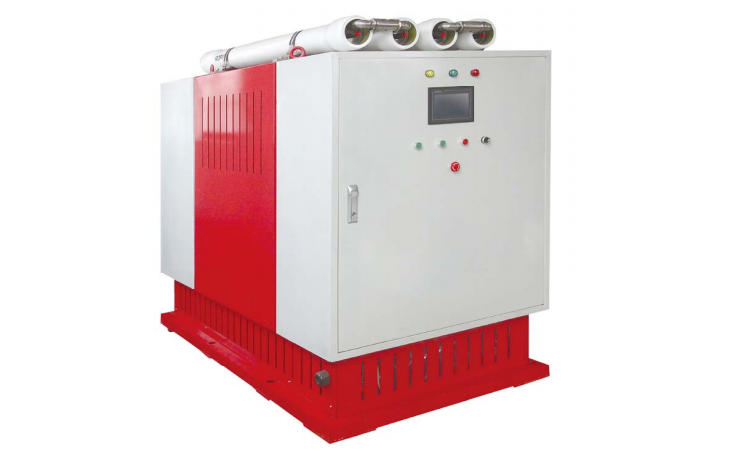
Intelligent Seawater Desalination High-Pressure Water Mist-Foam Integrated System
Uniquely integrates advanced technologies of seawater desalination, foam, and high‑pressure water mist. Easy installation, simple operation and maintenance.
Innovative self‑lubricating axial piston pump technology – breaks the traditional use of mineral oil as lubricating and cooling medium; uses water both as transmission medium and lubricating/cooling medium, resulting in higher safety and cleanliness.
Swashplate nine‑piston axial technology – more compact structure, higher transmission/conversion efficiency, energy saving; pump body size is less than one fourth of conventional reciprocating pumps.
Advanced materials and processes ensure better wear resistance, better sealing, lower noise and longer service life.
Multi‑function integration, 3D optimization, small footprint, outstanding cost‑performance ratio.
Intelligent control platform, human‑machine interaction, flexible settings according to project requirements.
Full system remote monitoring capability, convenient data acquisition in both standby and operating modes.
Seawater desalination system adopts the world's most advanced reverse osmosis separation technology – high salt rejection, excellent water quality, stable output, intelligent dynamic adjustment.
World‑leading proportional mixing control device – more precise foam concentrate proportioning, lower consumption, more environmentally friendly.
Fire extinguishing agents stored at atmospheric pressure, flexible refilling, easy system reset.
Automatic switching among seawater desalination, foam and high‑pressure water mist states – secures water source while balancing fire‑fighting efficiency and economy.
| Basic Parameter | Unit | WE-HGP-110/10-12 | WE-HGP-220/10-12 | WE-HGP-330/10-12 |
|---|---|---|---|---|
| System model | WE-HGP-110/10-12 | WE-HGP-220/10-12 | WE-HGP-330/10-12 | |
| High-pressure pump model | WE110/12-1500 | WE110/12-1500 | WE110/12-1500 | |
| Number of pumps | pcs | 1 duty + 1 standby | 2 duty + 1 standby | 3 duty + 1 standby |
| Foam concentrate pump model | WE0.6H | WE0.6H | WE0.6H | |
| Number of foam pumps | pcs | 1 duty + 1 standby | 1 duty + 1 standby | 1 duty + 1 standby |
| Rated working pressure (fire) | MPa | 12 | 12 | 12 |
| Maximum working pressure (fire) | MPa | 16 | 16 | 16 |
| High-pressure water flow rate (fire) | L/min | 110 | 220 | 330 |
| Foam concentrate flow rate | L/min | 1.5-10 | 1.5-10 | 1.5-10 |
| Foam mixing ratio | % | 1 or 3 | 1 or 3 | 1 or 3 |
| Power consumption (fire mode) | kW | 33 | 63 | 93 |
| Dual water inlet connection | mm | 2×G1 1/2″ | 2×G1 1/2″ | 2×G1 1/2″ |
| High-pressure water outlet | mm | DN25 | DN32 | DN32 |
| Fresh water tank volume | L | 520 or as specified per project (304 stainless steel) | ||
| Foam tank volume | L | 130 | 270 or as specified per project (304 stainless steel) | |
| Reverse osmosis membrane model | Hydranautics | SWC6-4040 | SWC6-4040 | SWC6-4040 |
| Working pressure (desalination) | MPa | 4-7 | 4-7 | 4-7 |
| Desalination power consumption | kW | 5-20 | 5-20 | 5-20 |
| Daily fresh water production | m3 | 5-40 | 5-40 | 5-40 |
| Salt rejection rate | % | 99.7 | 99.7 | 99.7 |
| Water recovery rate | % | 38 | 38 | 38 |
| Operating temperature range | °C | 5-40 | 5-40 | 5-40 |
| High-pressure pump body material | 2205 Duplex stainless steel | |||
| Foam pump body material | 2205 Duplex stainless steel | |||
| Jockey pump body material | 304 stainless steel | 304 stainless steel | 304 stainless steel | |
| Pump skid dimensions | mm | 1350×960×1650 | 1750×960×1650 | 1750×960×1650 |
| Pump skid weight | kg | 1270 | 1580 | 1860 |
Shipbuilding industry standard CB/T 3753-1995 "Reverse osmosis seawater desalination unit"
China Classification Society (CCS) "Rules for Classification of Sea-going Steel Ships"
China Classification Society (CCS) "Code for Construction of Offshore Platforms"
China Classification Society (CCS) "Guidelines for Product Inspection"
GJB 4000-2000 "General specifications for naval ships"
GJB 4064-2000 "General specifications for seawater desalination units of naval ships"
GB/T 22241-2008 "General technical specifications for marine water mist fire extinguishing systems"
1974 SOLAS Convention 2000 Amendment Reg.II-2/10.5.6
MSC/circ.913 "Guidelines for the approval of fixed local water‑based fire‑fighting systems for use in category A machinery spaces"
CCS Chief Engineer Office (2007) Circular No.018/Total No.253 "Revised interpretations concerning fixed local water‑based fire‑fighting systems for category A machinery spaces"
1974 SOLAS Convention 1981 Amendment Chapter II-2/61 "Fixed deck foam systems"
International Fire Safety Rules (FFS) Chapter 14 "Fixed deck foam systems"
IMO Resolution A.855(20) "Standards for helicopter facilities on board ships"
GB20031-2005 "General technical specifications for foam systems and components"
National Electrical Code NEC
Technical requirements proposed by design institutes, shipyards and ship owners
Copyright 2026 WoerTechnology Co., Ltd. All rights reserved.  浙ICP备19023994号-1


